
- English
- Afrikaans
- беларускі
- Hrvatski
- Bosanski
- Монгол хэл
- IsiXhosa
- Zulu
- Hawaiian
- Lëtzebuergesch
- Español
- Português
- русский
- Français
- 日本語
- Deutsch
- tiếng Việt
- Italiano
- Nederlands
- ภาษาไทย
- Polski
- 한국어
- Svenska
- magyar
- Malay
- বাংলা ভাষার
- Dansk
- Suomi
- हिन्दी
- Pilipino
- Türkçe
- Gaeilge
- العربية
- Indonesia
- Norsk
- تمل
- český
- ελληνικά
- український
- فارسی
- नेपाली
- български
- ລາວ
- Latine
- Қазақша
- Euskal
- Eesti Keel
- Română
- Slovenski
- Srpski језик

Why Is a Drawn Rim Important for Flame Weeder Handle Covers?
A drawn rim is more than an edge detail on a Flame Weeder Torch Handle Cover. It helps locate the cover against the handle tube, reduces the direct entry of dust, grass clippings, and rain, and supports consistent assembly. At Huading, we combine metal casting and precision CNC machining to manufacture custom metal components with a stated machining tolerance of ±0.01 mm. This article explains how rim geometry, keyhole slots, material selection, and machining accuracy affect the fit and service performance of flame weeder handle covers.
Table of Contents
- What Does a Drawn Rim Do on a Flame Weeder Handle Cover?
- How Does the Rim Help Protect the Handle Tube?
- Why Do Rim Geometry and Keyhole Slots Work Together?
- Which Materials Are Suitable for Handle Covers?
- How Do Casting and CNC Machining Affect Fit?
- Product Specifications and Applications
- How Huading Supports Custom Metal Components
- Frequently Asked Questions
What Does a Drawn Rim Do on a Flame Weeder Handle Cover?
When we look at a flame weeder handle assembly, the end cover may seem like a relatively simple component. However, its geometry affects how the handle tube is closed, how mounting hardware is positioned, and how well the assembly handles outdoor working conditions.
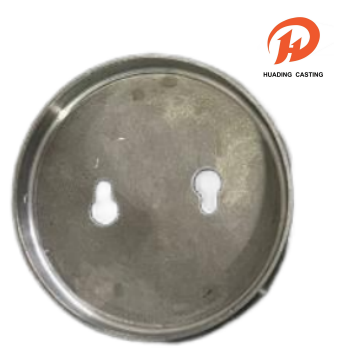
One important feature is the drawn rim. On our Flame Weeder Torch Handle Cover, this raised edge is designed to locate against the handle tube and create a more controlled interface between the cover and the tube end. Rather than relying on a flat disc alone, the rim provides an additional locating surface during installation.
We consider this particularly useful for agricultural equipment because flame weeders are often used in environments containing soil, dry vegetation, grass clippings, and moisture. A cover that sits unevenly or leaves an unnecessarily exposed gap can allow debris to collect around the handle opening.
The drawn rim addresses this issue through its surrounding geometry. It helps position the cover and reduces direct exposure at the tube end. The actual level of environmental protection still depends on the mating dimensions, clearances, and overall assembly design.
How Does the Rim Help Protect the Handle Tube?
During outdoor operation, a flame weeder handle can encounter more than heat-related working conditions. Dust, loose plant material, rain, and repeated handling can all affect exposed component interfaces.
We pay attention to three practical functions when designing the rim of a handle cover:
1. Reducing Dust and Grass Clipping Entry
The raised rim surrounds the tube-end interface and helps reduce the direct path through which dust and cut vegetation can enter. This is useful when equipment is operated near dry grass, agricultural fields, garden beds, and roadside vegetation.
2. Managing Rainwater Exposure
A properly matched rim can reduce direct exposure of the handle opening to rain and splashing water. However, a raised edge alone should not be treated as a waterproof seal. If the application requires a defined water-resistance level, the complete interface needs to be evaluated, including clearances, contact surfaces, and any additional sealing elements.
3. Improving Cover Positioning
The rim also acts as a locating feature. When the cover is installed, its geometry helps establish the intended position relative to the handle tube. This reduces dependence on visual alignment and makes assembly more consistent.
In our experience, this locating function is just as important as environmental protection. A cover that fits correctly from the beginning is easier to assemble and less likely to require repeated adjustment.
Why Do Rim Geometry and Keyhole Slots Work Together?
A drawn rim cannot solve every assembly problem by itself. The fastening structure also determines whether the cover can be installed, removed, and reinstalled efficiently. This is why we combine the rim design with two keyhole-shaped mounting slots.
The keyhole slots allow the cover to engage with the mounting fasteners without completely removing the screws. During maintenance, the operator can loosen the fasteners, release the cover from the slots, and remove it without having to take the screws out entirely.
For equipment that may require inspection or replacement of handle-end components, this small structural detail can save time and reduce the risk of losing mounting hardware.
| Design Feature | Main Function | Practical Benefit |
|---|---|---|
| Drawn Rim | Locates against the handle tube | More consistent positioning and reduced direct debris entry |
| Two Keyhole Slots | Engage with mounting fasteners | Faster cover removal without fully removing screws |
| Mirrored Slot Layout | Defines the correct installation orientation | Helps prevent reversed assembly |
| One-Piece Casting | Integrates the cover structure into one component | No separate joints within the cast cover body |
| Chamfered Edge | Reduces the sharpness of the outer edge | More comfortable handling and a cleaner finish |
Another detail worth considering is slot orientation. Our design uses mirrored slots to establish one intended fitting direction. This helps reduce assembly mistakes when operators handle multiple components during production or maintenance.
For us, good component design is not simply about making a part strong. It is also about making the correct assembly process straightforward and repeatable.
Which Materials Are Suitable for Flame Weeder Handle Covers?
Material selection affects component weight, mechanical performance, corrosion behavior, machining requirements, and production cost. For a Flame Weeder Torch Handle Cover, we consider the actual working environment and the requirements of the complete handle assembly before recommending a material.
Carbon steel and aluminum are two material options listed for this product. Stainless steel can also be evaluated for customized designs when the drawing and manufacturing requirements call for it.
| Material | Key Characteristics | Considerations |
|---|---|---|
| Carbon Steel | Good mechanical strength and suitable for various metal component designs | Surface protection may be required depending on moisture exposure and operating conditions |
| Aluminum | Lower density and good machinability | Alloy selection should match the required strength and casting process |
| Stainless Steel | Good corrosion resistance depending on grade | Grade, manufacturing method, and cost need to be evaluated against the application |
We do not recommend choosing a material based on weight or price alone. For example, an aluminum cover may be suitable when reducing handle-end weight is important, while carbon steel may be considered when the design prioritizes a different balance of strength and cost.
For custom orders, we review the material specification, component dimensions, mounting requirements, and expected operating environment before confirming the production solution.
How Do Casting and CNC Machining Affect Fit?
A well-designed rim still needs to be manufactured accurately. Small dimensional differences around the locating surface or mounting slots can affect how the cover sits against the handle tube and how the fasteners engage.
At Gaomi Huading Metal Products Co., Ltd., we have been engaged in metal product manufacturing since 1996. Our production capabilities cover casting, metal processing, and the development of customized mechanical components.
For this type of component, we focus on several manufacturing and inspection considerations:
One-Piece Casting Structure
The one-piece casting design integrates the main cover body without requiring separate joints between the cover's structural sections. This avoids additional connections that could loosen during handling or service.
Precision CNC Machining
Our CNC machining capability supports accurate processing of specified dimensions and functional interfaces. For suitable machined features, our stated machining tolerance can reach ±0.01 mm. This tolerance applies to the relevant machined dimensions, not automatically to every as-cast surface or the complete finished component.
CMM Dimensional Inspection
We use coordinate measuring machine (CMM) inspection to check critical dimensions against technical drawings. For a handle cover, important inspection points may include the rim diameter, overall thickness, slot dimensions, slot spacing, and mounting positions.
| Quality Control Item | Inspection Focus | Why It Matters |
|---|---|---|
| Rim Dimensions | Diameter, height, and locating geometry | Supports correct positioning against the handle tube |
| Keyhole Slots | Opening size, spacing, and orientation | Ensures compatibility with mounting fasteners |
| Machined Features | Specified dimensional tolerances | Controls critical assembly interfaces |
| Surface Condition | Visible casting defects and machining finish | Supports appearance and functional requirements |
| Final Inspection | Drawing compliance and dimensional verification | Reduces the risk of nonconforming parts reaching shipment |
We believe inspection should focus on the dimensions that affect actual assembly rather than measuring every feature with the same level of attention. This approach makes quality control more relevant to the component's intended function.
Product Specifications and Applications
Our Flame Weeder Torch Handle Cover is designed as an end-cover component for flame weeder handle assemblies. Its round disc structure, drawn rim, and two keyhole slots combine positioning, fastening, and protective functions.
| Parameter | Specification |
|---|---|
| Product Name | Flame Weeder Torch Handle Cover |
| Material Options | Carbon Steel / Aluminum; stainless steel available for customized evaluation |
| Structure | One-Piece Casting |
| Mounting Design | Two Keyhole Slots with Mirrored Orientation |
| Edge Design | Drawn Rim and Chamfered Edge |
| Machining Tolerance | Up to ±0.01 mm on applicable CNC-machined features |
| Inspection | CMM Dimensional Inspection |
| MOQ | 100 pcs |
| OEM & ODM | Accepted; custom production according to drawings or samples |
| Sample Lead Time | Usually around 7 days, subject to sample complexity |
| Packaging | Thickened Bubble Bag and Carton or Seaworthy Pallet |
| Shipping Methods | DHL, UPS, FedEx, or LCL by Sea |
Typical application areas include:
- Flame weeder handle assemblies used in agricultural weed control.
- Outdoor thermal weed-control equipment.
- Replacement handle-end components for maintenance and repair.
- Customized metal covers for agricultural machinery and related equipment.
For equipment manufacturers, matching the cover to the existing handle tube and fastener arrangement is essential. We recommend confirming the tube diameter, rim dimensions, slot spacing, material, and mounting orientation before placing a production order.
How Huading Supports Custom Metal Components
Gaomi Huading Metal Products Co., Ltd. was founded in 1996. We are a manufacturer integrating research, metal casting, and machining, with experience in the development and production of mechanical parts and metal products.
Our work covers more than producing a component according to a fixed specification. We also support customers who need to adjust material, dimensions, structural details, or machining requirements for a particular equipment assembly.
For custom Flame Weeder Torch Handle Cover projects, we can work with customer drawings or physical samples to evaluate the following details:
- Drawing Review: Checking the rim profile, overall dimensions, slot positions, and mounting interfaces before production.
- Material Selection: Evaluating carbon steel, aluminum, or other suitable materials according to the application.
- Sample Development: Supporting sample production, usually within approximately 7 days depending on design complexity.
- Dimensional Inspection: Using CMM equipment to verify critical dimensions against the approved drawing.
- Flexible Ordering: Supporting a standard MOQ of 100 pieces for this product.
- Export Packaging: Providing thickened bubble bag protection, carton packing, or seaworthy pallet packaging.
We also operate under a quality management system certified to GB/T 19001-2016 / ISO 9001:2015. Our focus is on maintaining consistent production requirements, checking critical dimensions, and arranging delivery according to the agreed order schedule.
When developing a new metal cover, we encourage customers to share the original component drawing or a physical sample. This allows us to review the fit, machining requirements, and production feasibility before confirming the final specifications.
Frequently Asked Questions
1. What is the main function of a drawn rim on a Flame Weeder Torch Handle Cover?
The drawn rim helps locate the cover against the handle tube and reduces direct exposure of the tube opening to dust, grass clippings, and rain. It also provides a more defined positioning interface during assembly.
2. Does a drawn rim make the handle cover completely waterproof?
No. A drawn rim can help reduce direct water entry, but it does not automatically create a waterproof seal. Waterproof performance depends on the complete assembly, including the mating surfaces, clearances, fastening arrangement, and any additional sealing components.
3. Why does the handle cover use keyhole-shaped mounting slots?
Keyhole slots allow the cover to engage with mounting screws without requiring the fasteners to be completely removed. This makes installation and maintenance more convenient and reduces the risk of losing screws.
4. Can Huading manufacture the handle cover according to a customer drawing?
Yes. We accept OEM and ODM projects and can develop customized metal covers according to technical drawings or physical samples. Dimensions, materials, rim geometry, slot positions, and machining requirements can be reviewed before production.
5. What machining tolerance can Huading achieve?
Our precision CNC machining capability can reach ±0.01 mm on applicable machined features. The achievable tolerance for each feature depends on its geometry, material, manufacturing process, and inspection requirements.
6. What is the minimum order quantity for this product?
The listed MOQ for the Flame Weeder Torch Handle Cover is 100 pieces. We can discuss order requirements and production arrangements for customized projects.
7. How long does sample production take?
Sample production usually takes around 7 days, depending on the component structure, material, tooling requirements, and machining complexity. We confirm the actual schedule after reviewing the drawing or sample.
8. What information should be provided when requesting a quotation?
We recommend providing a 2D drawing or 3D model, material requirements, annual or estimated order quantity, critical dimensional tolerances, surface treatment requirements, and intended application. If a drawing is unavailable, a physical sample can also help us evaluate the component.
At Huading, we see the drawn rim as a functional design feature rather than a decorative edge. When its geometry is matched with the handle tube, mounting slots, and manufacturing tolerances, it helps create a more practical and serviceable handle cover. For custom metal components, we focus on getting these details right before production begins.
To discuss a customized Flame Weeder Torch Handle Cover, you can contact our team with your drawings or sample requirements for a manufacturing evaluation.